
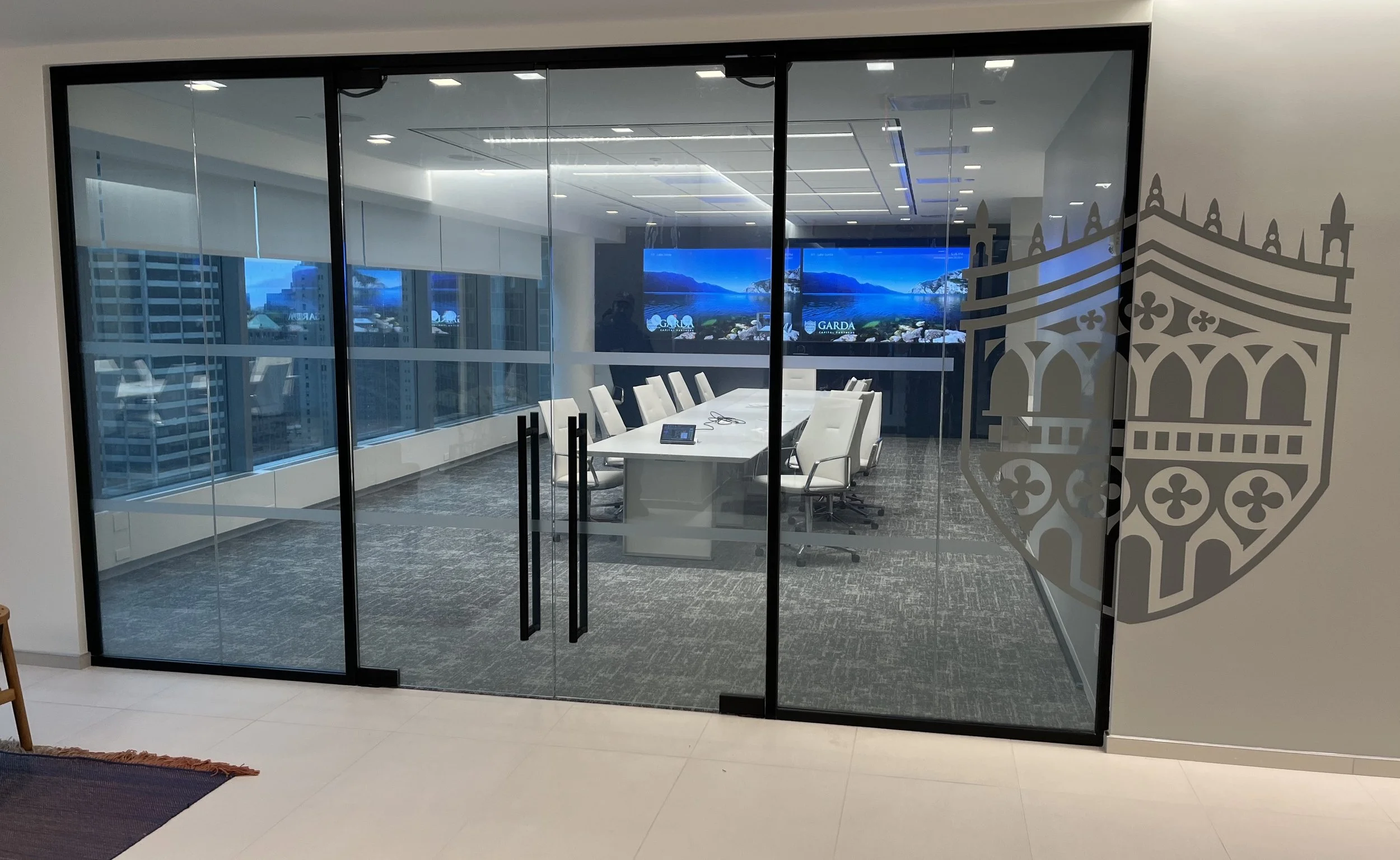
A glass conference room is a good idea about ninety percent of the time. The other ten percent is a salary review, a deal room, a patient, or a laptop screen nobody outside the meeting should be reading. Blinds solve it badly: they collect dust, they get left down for weeks, and they undo the reason the glass was specified in the first place.
Smart film for glass is the other answer. It is a film applied to the pane you already own, and a switch that turns that pane from frosted to clear. The technology is usually written as switchable film, switchable privacy glass, electric privacy glass or PDLC film, and all four phrases describe the same behavior.
One fact about that behavior decides most of the specification, and it is the one buyers get backwards. This guide covers what the film is, what the powered and unpowered states actually do, what has to be at the glass for it to work, and the cases where a passive film from the Chroma decorative glass film range is the better buy. APG supplies the switchable version as Chromatic Smart Films.
Key points
- Smart film is a film, not new glazing. It goes onto glass the building already has.
- Frosted is the unpowered state. Privacy is free; clarity is what draws current.
- APG states the switch from clear to opaque happens in under a second, by wall switch, remote or building automation.
- Power has to reach every pane you want to switch. That electrical route, not the film, is what makes a retrofit easy or awkward.
- If the glass should be private at every hour, a frosted or patterned film does the same job with no wiring and no running load.
What smart film for glass actually is
It is a laminate bonded to the glass surface with a layer of liquid crystal inside it. APG describes Chromatic Smart Films as using liquid crystal technology, applied directly to existing glass surfaces. Nothing in the window assembly changes. The pane, the frame and the glazing gasket all stay where they are.
With no voltage across the film, the liquid crystals sit in random orientations. Light hitting them scatters instead of passing straight through, so the pane reads as an even frosted white. Apply voltage and the crystals line up along the field. The scattering stops, and the pane goes clear.
That is the whole mechanism, and it is worth stating plainly because the marketing language around this product category tends to obscure it. There is no tinting, no chemical reaction and no moving part. There is a layer that either scatters light or does not, and a switch that decides which.
It sits in APG's glass film range alongside products that do the same job passively: 3M FASARA films, reeded glass films, Chroma Transparent color films and printed design window films. The difference is not the look. It is whether the look can change.
Off is private, on is clear, and that shapes the whole job
Here is the fact people get backwards: the film does not need power to give you privacy. It needs power to take privacy away.
APG's own description is specific about this. Powered off, the film appears frosted, creating a private, diffused look. Powered on, the liquid crystals align and the glass becomes clear. So the default condition of a smart film partition, at two in the morning, during a power cut, or before the controller is commissioned, is frosted.
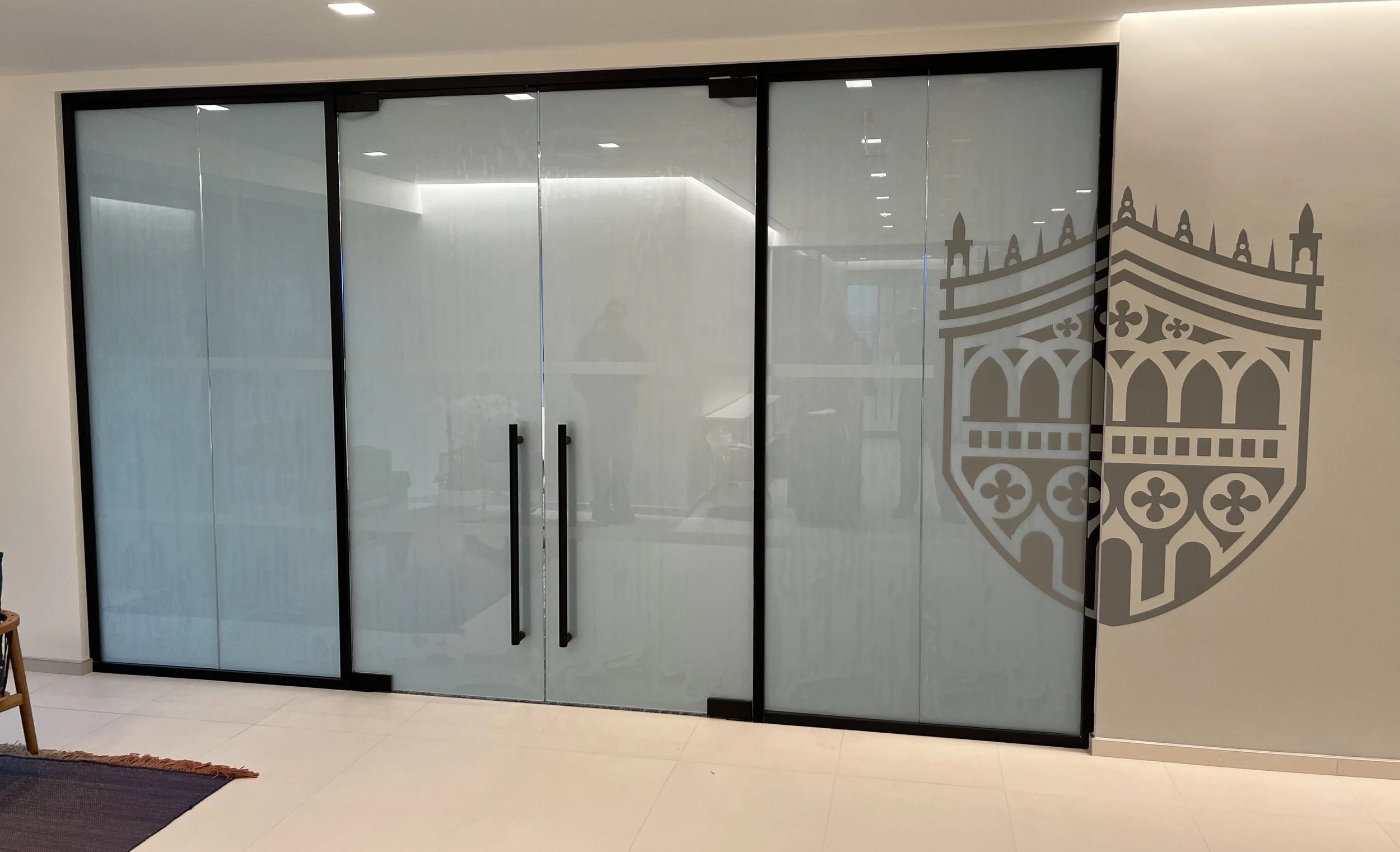
For most security and privacy programs that default is the right way round. A film that failed clear would put a deal room on display every time a breaker tripped. This one fails private.
What it means for a room that is clear most of the day
It also means the usage pattern is worth thinking about before the order goes in. An open-plan meeting room that reads as clear glass nine hours a day is drawing current for nine hours a day. A patient exam room that is frosted by default and switched clear only when a clinician wants a sightline draws almost nothing.
Neither is a problem. Both are a design input. The room that wants to be clear nearly all the time and private twice a week is the room where you should at least price a passive film plus a door, because the film is doing very little work for its money.
The two states, and what each one costs you
| State | What you see | Power |
|---|---|---|
| Off | Frosted, diffused. Daylight still comes through; the view does not. | None |
| On | Clear. Full view through, glass reads as ordinary glazing. | Continuous while clear |
| Power failure | Frosted. The glass fails to the private state. | None |
Behavior as described on APG Design Studio's Chromatic Smart Films page, read 28 September 2026. Operating voltage and the power draw per square foot are not published there (to confirm).
How it is switched, and what has to be at the glass
APG lists three control routes: a wall switch, a remote control, or a smart integration, and states the film is compatible with most building automation systems. Switching is immediate, given as under a second from clear to opaque.
The control method is the easy decision. The one that affects drawings is where the power goes. Every pane you want to switch independently is its own circuit and its own zone. Three conference rooms with one switch each is a different electrical drawing from a twelve pane storefront that has to switch as one.
Ask for three things before the film is ordered:
- The zone map. Which panes switch together, and how many separate switches the client expects to press.
- The route for the supply to each pane, and who conceals it. Frame, mullion, ceiling or floor box.
- The operating voltage, the controller or transformer the film needs, and the load per square foot, so the electrician is sizing to a real number (to confirm: APG does not publish these figures).
Retrofit is genuinely the film's strength here. APG describes it as retrofittable, designed to work with existing glass, with no need for full window replacements, and says installation is applied directly to the existing glass with minimal disruption. The disruption that remains is electrical, not glazing.
What APG publishes
Four numbers from the spec, and none of them involve new glass
Every figure below is stated on APG Design Studio's own pages. Nothing here is modeled or estimated.
Under 1 sec
Switch time from clear to opaque on Chromatic Smart Films
0 panes
Glass replaced. The film is applied to the glazing already in the opening
50+ designs
Patterns in the 3M FASARA range, the passive alternative when privacy never needs to switch off
6 states + DC
Where APG has its own installation staff: NY, NJ, PA, CT, MD, VA and Washington DC
Source: APG Design Studio, Chromatic Smart Films, Glass Finishes and the Custom Graphics FAQ, read 28 September 2026.
Where switchable film earns its cost, and where it does not
Switchable film is the right specification when the same piece of glass has two jobs at different hours. That is a narrower case than the product's popularity suggests, and being honest about it is how you avoid a client paying for a switch nobody uses.
It earns its cost when:
- The room is booked by different people for different purposes through the day, and the privacy requirement changes with the booking.
- The client wants the glass to read as clear glass when it is not in use, which rules out any permanent pattern.
- Blinds are the incumbent and the real complaint is maintenance, dust or the look of them. APG makes exactly this point: the film removes bulky window treatments that collect dust and wear over time.
- Privacy has to be demonstrable on demand, as in a healthcare exam room or an observation room.
A passive film is the better buy when the privacy requirement is constant. Nobody switches a restroom, a stairwell or a server room glass line. In those openings a frosted or patterned film gives the same result with no circuit, no controller and nothing to commission, and the design options are wider: patterned FASARA, a Chroma gradient, a color layer, or a printed graphic carrying the tenant's brand.
Four ways to make glass private, compared
| Product | What the privacy does | Power |
|---|---|---|
| Chromatic switchable film | On demand. Frosted or clear, changed by a switch in under a second. | Yes, to stay clear |
| FASARA or Chroma decorative film | Constant. Scatters the view, keeps the daylight, 50+ patterns. | None |
| Gradient film | Constant, at seated eye level only. Blocks the sightline, leaves the top of the pane clear. | None |
| Reflective window film | Daytime only, on exterior glass. Reverses after dark when the interior is lit. | None |
Product behavior as described across APG Design Studio's Chromatic, Glass Finishes, decorative film and 3M Night Vision pages.
The four settings APG names for it
APG lists four application groups on the Chromatic page, and each one is a different reason to buy the same film.
Corporate offices. Private meeting rooms, executive suites and shared spaces that have to adapt, without blinds or a permanent partition. This is the volume case, and it usually arrives alongside other glass work: a partition line that also wants patterned film in the circulation zone, or an elevator interior being refinished in the same phase.
Healthcare facilities. Exam rooms, waiting areas and observation rooms, where the film has to give patient privacy while still meeting hygiene and safety requirements. A hard, wipeable glass surface with no fabric and no slats is the reason this application keeps coming up.
Residential spaces. Bathrooms, street facing windows and home offices in the kind of building where the glazing is the architecture and blinds would spoil it. APG names the luxury residential tower specifically.
Retail and hospitality. Storefronts, fitting rooms and hotel bathrooms. A storefront that can go opaque out of hours and clear when the shop opens is a different proposition from one carrying a printed window graphic, and the two are often specified together on the same elevation.
Smart film against switchable glass: what you are buying
Two products get sold under the phrase switchable privacy glass, and the difference matters to your budget and your program.
Switchable glass is a glazing unit with the liquid crystal layer laminated inside it at the factory. You buy new glass, and it arrives with the function built in. That suits new construction and it suits an owner replacing glazing anyway.
Switchable film is applied to the pane in the opening. APG's position is explicit: designed to work with existing glass, no need for full window replacements. For a tenant fit out, a floor being refreshed between leases, or any building where pulling glass is not on the table, this is the only version of the product that is actually available to you.
The trade off is that the film sits on one face of the glass rather than inside a laminate, so surface condition and edge detail matter, and the wiring has to be concealed on site rather than in a factory. That is a job for an installer who does this work regularly, not a general contractor's spare afternoon. APG's Custom Graphics FAQ states the company keeps a full staff of professional installers in New York, New Jersey, Pennsylvania, Connecticut, Maryland, Washington DC and Virginia, with a network of installation partners for the rest of the United States, and that installation is a separate service from the material.
What to settle before the order goes in
Five things, and three of them are not on anybody's website.
- The zone map. Panes, switches, and which panes move together. Get it drawn, not described.
- The electrical route. Where the supply reaches each pane and who is responsible for hiding it.
- Maximum panel size. Switchable film comes in finite widths, and a tall single pane may need a seam. The maximum single piece size is not published (to confirm).
- Lead time. APG's FAQ gives 5 to 10 business days as the typical production window for printed glass film and wall graphics. A switchable film order sized and wired to your glass is a different product, and its lead time is not published (to confirm).
- Warranty, and what voids it. Term and coverage for Chromatic are not published (to confirm).
One more piece of the FAQ is worth using. APG says that once a design is settled it provides a digital rendering of the finished work in your space, then a physical sample before production. On a switchable job, ask for the sample powered. A frosted state is easy to picture from a photo; what the clear state looks like at an angle, in your daylight, is not.
Frequently asked questions
What is smart film for glass?
A switchable film applied to glass you already have. APG describes Chromatic Smart Films as using liquid crystal technology: powered off the film appears frosted and diffused, powered on the crystals align and the glass becomes clear. It goes onto existing glass, so the glazing does not have to be replaced.
Does smart film need electricity to stay private?
No, the opposite. Frosted is the unpowered state, so privacy is what the glass does with no power at all. Clarity is the state that draws current. A room that must read as clear all day is the one carrying a standing load.
How fast does it switch?
APG states clear to opaque in under a second, by wall switch, remote, or smart building integration, and says the film is compatible with most building automation systems.
Can it go on existing windows and partitions?
Yes. APG describes the film as retrofittable and designed to work with existing glass, with no need for full window replacements. Power still has to reach the glass, so the electrical route is the part to settle early.
When is a passive film the better choice?
When the glass should be private all the time and nobody needs to switch it. A frosted or patterned film such as 3M FASARA, available in more than fifty designs, does that with no wiring, no controller and no running load.
What does it cost?
APG does not publish pricing for Chromatic, so no figure is quoted here (to confirm). The variables are glass area, the number of separately switched zones, and the electrical work to reach each pane. Price it against your glass schedule rather than per square foot in the abstract.
Specifying it on a live building
Smart film is a small product with an outsized effect on how a floor plate can be used, and the decision is usually made in the wrong order. Teams choose the film, then discover the wiring. Do it the other way round: work out which panes genuinely need to change state, draw the zones, find the route for the power, and let that tell you how much switchable glass the project can justify. Everything else on the glass line can be a passive film, and will cost less.
APG Design Studio supplies and installs both. You can see the switchable range on the Chromatic Smart Films page, the passive options across Chroma glass films and 3M window films, and finished work in the project portfolio. If you have a glass schedule and a privacy problem, send the dimensions and the room uses through the new project form or contact the studio, and ask for the zone map before the quote.